
70V Speakers and Multi-Zone Amplifiers: Matching Music and Volume to Every Space
Learn how 70V distributed speakers and zone-capable amplifiers help each area of a business play the right music at the right level.
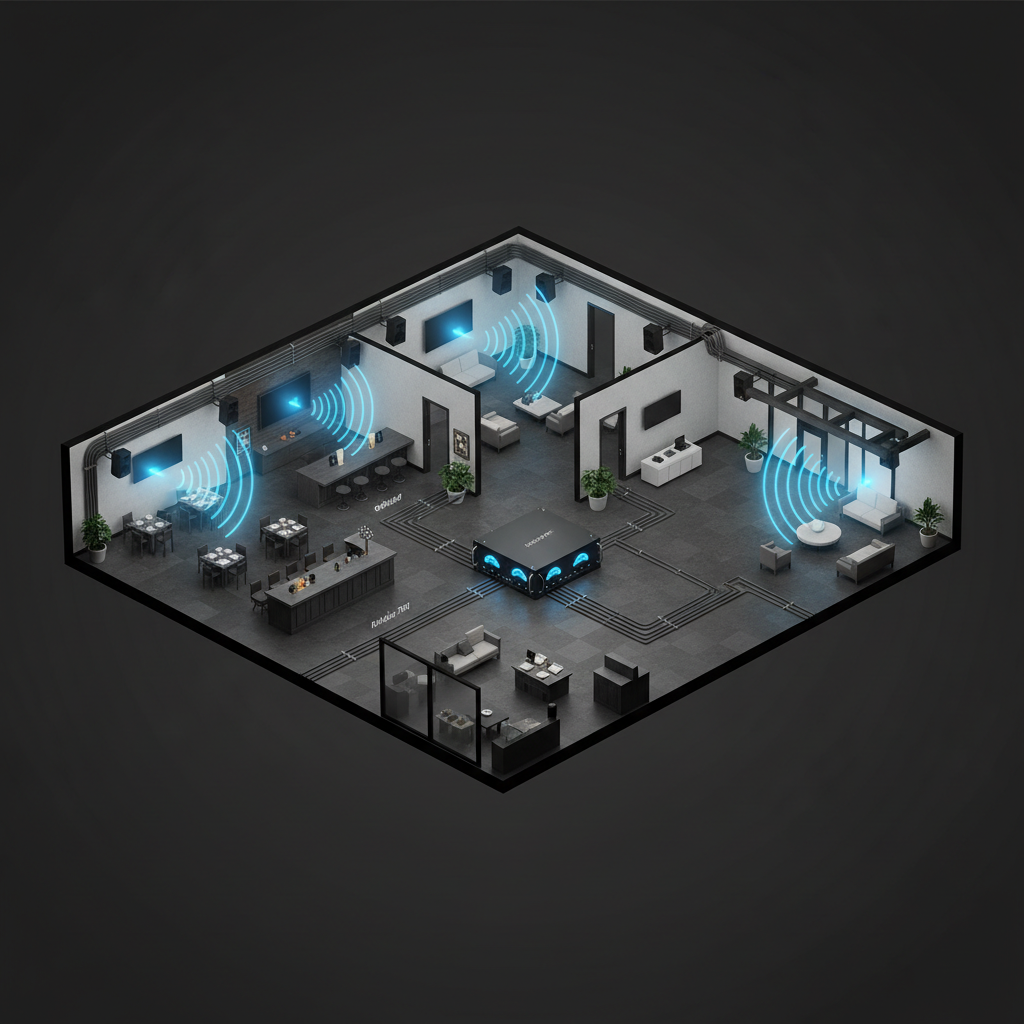
One music source at one volume everywhere rarely fits a real building. A dining room, bar, patio, restrooms, lobby, offices, and warehouse can each call for different content and loudness. Distributed speakers help sound reach those spaces; zones let staff control what each space hears.
What does 70V constant-voltage mean?
In a 70V system, the amplifier supplies a nominal 70.7V line; 100V systems are also common internationally. Each speaker has a transformer with selectable wattage taps, often including settings such as 1, 2, 4, and 8 watts. Speakers connect in parallel, so many can share one amplifier channel. Add up the selected taps on that channel and keep the total within its rated output. As a design guideline, leaving around 20% headroom helps avoid sizing a channel right at its limit.
Why use 70V speakers?
A 70V line makes it practical to connect many speakers to one channel across long runs, often with smaller-gauge wire and less loss than an equivalent low-impedance 8-ohm run. Parallel wiring is straightforward, and taps provide a way to adjust individual speakers: quieter near a host stand, for example, and more output near a busy kitchen. If an amplifier channel has capacity left, additional speakers can be planned without rebuilding the entire system. That flexibility makes 70V a common choice for restaurants, retail spaces, offices, and warehouses.
There are trade-offs. Transformers in budget speakers can limit deep bass at higher levels. Where a bar or fitness area needs more full-range punch, low-impedance speakers or an added subwoofer may be a better fit. A building can use both approaches on appropriately rated, separate amplifier channels.
Design zones around the people using each space
Zones let content and loudness fit the environment rather than forcing every room to follow one setting. A dining room might need soft background music that leaves conversation comfortable, while a bar can support a livelier mix. A lobby or reception area may call for something calm, and restrooms may need only a low level. A patio may need more output to compete with traffic and wind; offices may be quiet or receive paging only; and a warehouse may prioritize understandable announcements over music. These are starting points, not rules—set levels by listening in the occupied space.
Source selection matters as much as volume. Different zones can play different playlists when the source and routing equipment support it: an upbeat selection on a retail floor and something mellower in a dining area, for example. Genre and tempo should suit how people use each space.
Choosing an amplifier for your zones
A single-channel mixer-amplifier serves one independently controlled zone. A multi-channel 70V amplifier can dedicate a channel to each zone. For more flexible source routing, a zone mixer or matrix mixer/DSP can direct selected inputs to selected zones through suitable amplifier channels. Match the approach to the controls staff actually need, not just the number of speakers.
- Count the independent channels and decide whether each zone needs its own source selection.
- Sum the speaker taps for each zone and choose enough rated power per channel with headroom.
- Consider DSP features such as EQ, limiters, and a high-pass filter suited to protecting 70V speaker transformers.
- Plan priority paging and music ducking for the zones that should hear announcements.
- Decide whether scheduling, per-zone wall controllers, or network and app control would simplify daily use.
- Allow for rack space, ventilation, and growth room such as spare channels.
| Approach | Best for | Zone control | Considerations |
|---|---|---|---|
| Single-channel mixer-amplifier | A small space needing one shared audio area | One zone with shared source and level | Simple to operate, but separate areas cannot be controlled independently. |
| Multi-channel 70V amplifier | Several zones with dedicated amplifier channels | Independent output level per channel; source selection depends on the model and upstream equipment | Size each channel for its connected speaker taps and leave room for future zones. |
| Zone mixer plus amplifier | Spaces needing different sources routed to different areas | Per-zone source selection and level through the mixer | Check routing, paging behavior, and compatibility with the amplifier channels. |
| DSP/matrix processor with networked amps | Larger or more complex buildings needing flexible routing and controls | Configurable sources, processing, and controls for each zone | Requires thoughtful programming, staff-friendly controls, and a maintenance plan. |
Remember the music source
Zoning does not change music licensing requirements. If music plays for customers or employees, choose a source licensed for the intended business use and verify its coverage with the provider. Goff can integrate the business music source you choose; we do not sell music licenses.
Getting started
Walk the space and list the areas that should behave as separate zones. Note the content and loudness each needs, where paging must be heard, and the ceiling or mounting surfaces available for speakers. Goff Technologies can design the speaker layout and tap settings, size the amplifier channels, install the equipment, and train staff to use it. We work with businesses across Oklahoma—contact us to discuss how each space should sound.
Explore further
Services in this article
Questions about this topic
Keep reading
More insights

Verkada Transportation: Cloud-Managed Video and Telematics for Buses and Fleets
Explore Verkada Transportation’s vehicle cameras and gateway, and how school buses, transit agencies, and fleets can use video, GPS, and telematics.
Security Camera Types Explained: Multi-Sensor, 180°, Fisheye, PTZ, and More
See how commercial camera styles cover different spaces, where each has limits, and how to choose the right mix of overview and identification views for your business.
Commercial Audio Systems vs. a Bluetooth Speaker and a Personal Playlist
See why even coverage, reliable paging, simple controls, and properly licensed business music make a designed commercial sound system a better fit than a personal playlist.
Let's discuss your project.
Reach out today for a consultation and secure your business future.